Industrial Electrical EPC Contractor in West Bengal: Complete Guide for Large Projects
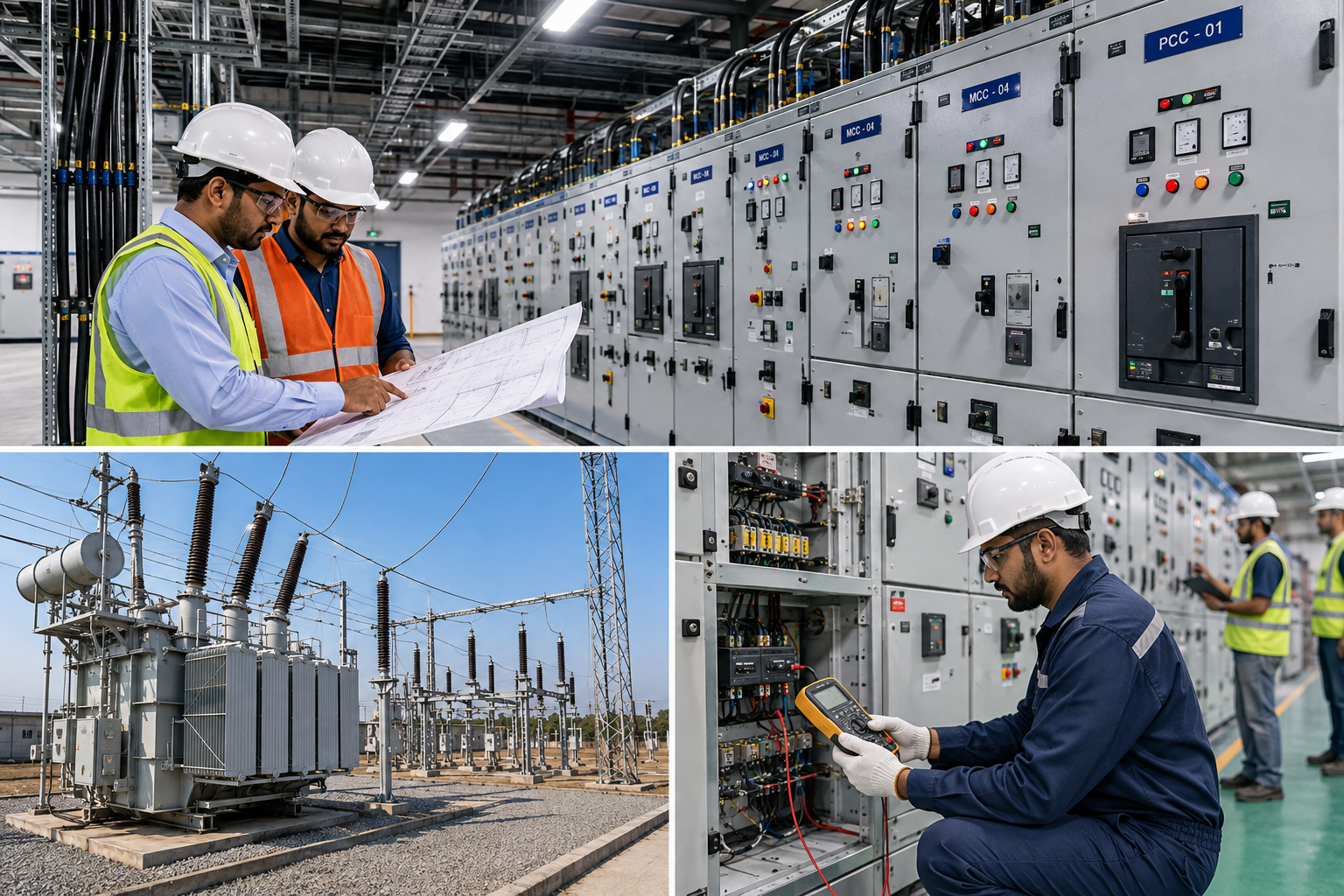
Large industrial projects need much more than an electrician or electrical material supplier.
A factory, manufacturing unit, warehouse, process plant or infrastructure project may require transformers, HT and LT distribution, switchgear, MCC and PCC panels, industrial cables, earthing, automation, power monitoring, protection systems, testing and commissioning.
Every component must work as part of one coordinated electrical system.
This is where an experienced industrial electrical EPC contractor in West Bengal becomes important.
An EPC partner can support the project from engineering and material planning through procurement, installation, testing and final commissioning.
For project owners, EPC consultants and procurement teams, choosing the right electrical partner can directly affect project cost, safety, reliability and commissioning schedules.
This guide explains what industrial electrical EPC work involves and what large projects should consider before selecting a contractor.
What Is an Industrial Electrical EPC Contractor?
EPC stands for:
Engineering – Procurement – Construction
In an industrial electrical project, these three areas are closely connected.
Engineering
Electrical engineering establishes how power will enter, move through and be controlled within the facility.
The engineering stage may include:
- Electrical load calculations
- Single-line diagrams or SLDs
- Transformer selection
- HT/LT system design
- Cable sizing
- Short-circuit considerations
- MCC and PCC planning
- Protection coordination
- Earthing system planning
- Cable routing
- Automation architecture
- Energy monitoring
- Electrical BOQ preparation
Engineering should normally be completed before major equipment procurement begins.
A poorly coordinated design can create expensive modifications during execution.
Procurement for Industrial Electrical Projects
Once the design and BOQ are finalized, the procurement stage starts.
Large projects can involve hundreds or thousands of electrical components.
Typical procurement categories include transformers, cables, switchgear, panels, control equipment, drives and field accessories.
The contractor must ensure that selected equipment meets the approved technical specification.
Price alone should not determine industrial procurement.
Important factors include technical compatibility, ratings, certifications, environmental conditions, availability, delivery schedules, maintenance requirements and future expandability.
For example, Polycab currently provides industrial cable categories including LV power, MV power, control and instrumentation cables. Its LV power cable range includes copper or aluminium conductor options with configurations including armoured and unarmoured cables.
Medium-voltage cables have a different role. Polycab describes its MV range as covering applications from approximately 3.3 kV to 66 kV, including industries, utilities, power plants and distribution networks.
Correct cable selection therefore depends on the actual system requirement rather than simply choosing a cable brand or conductor size.
Electrical Systems Required in a Large Industrial Project
A typical industrial facility may contain several interconnected electrical systems.
1. HT Electrical Distribution
Large industrial facilities often receive electrical power at high or medium voltage.
The incoming system may include equipment such as:
HT switchgear → protection → transformer → LT distribution
Depending on project requirements, equipment could include VCB panels, RMUs, protection relays, metering systems and transformers.
The exact configuration should be determined from the sanctioned power requirement, utility interface, plant load and electrical design.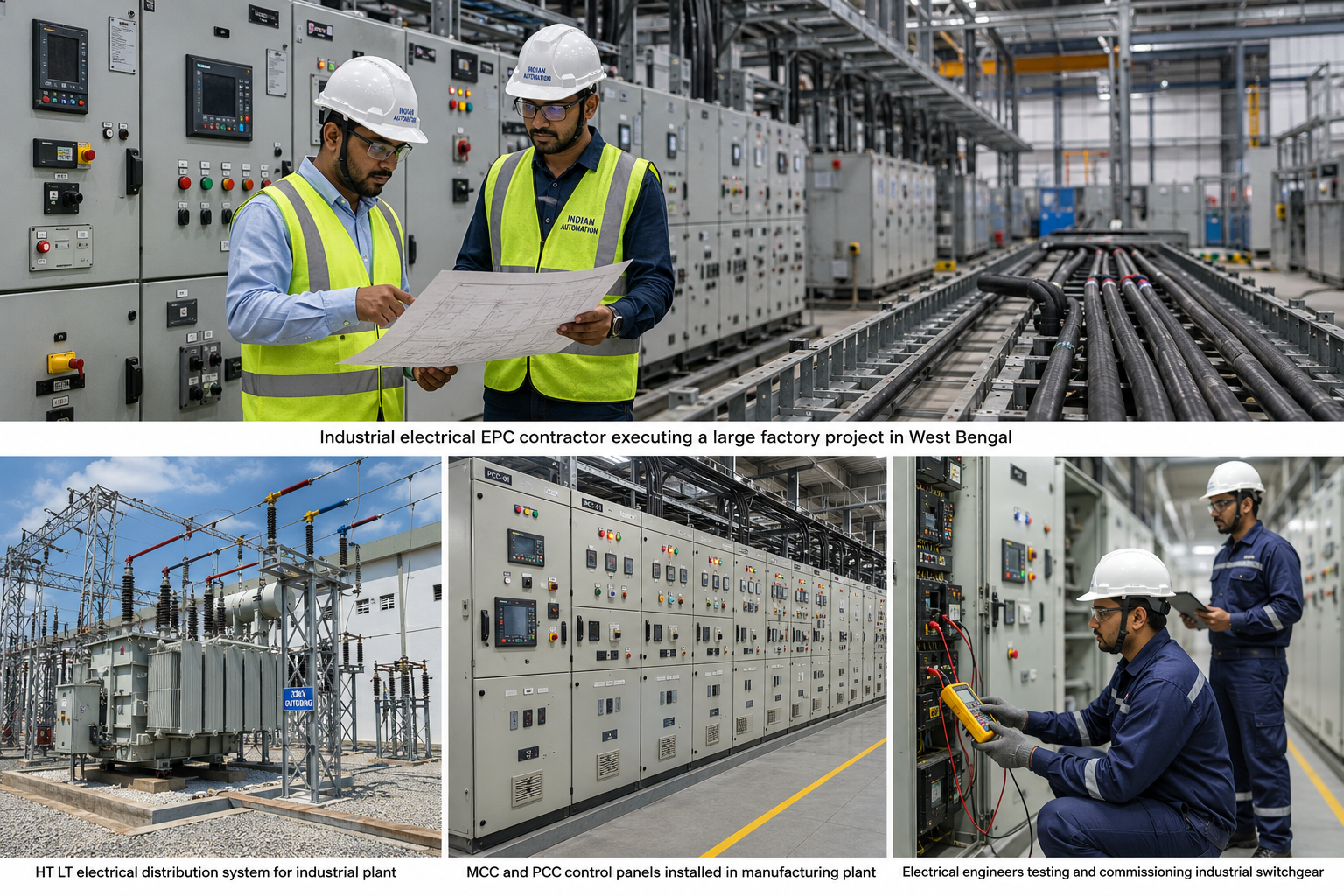
2. Transformers
Transformers are a critical part of industrial power distribution.
Transformer sizing should consider more than the present connected load.
Engineers may also need to evaluate:
current maximum demand, future expansion, starting characteristics of large motors, operating philosophy, redundancy and permissible loading.
Oversizing can increase unnecessary capital cost.
Undersizing can restrict future operation and expansion.
3. PCC Panels
A Power Control Centre (PCC) is commonly used for major electrical distribution within an industrial plant.
A PCC can distribute incoming power toward:
MCCs, process equipment, utility systems, sub-distribution boards and large individual loads.
Its specification can involve busbar rating, fault-withstand capability, incomer arrangement, outgoing feeders, metering, protection and communication requirements.
4. MCC Panels
A Motor Control Centre (MCC) is particularly important in plants containing numerous motors.
These may include motors for:
pumps, conveyors, compressors, cooling towers, blowers, process machines, ventilation systems and material-handling equipment.
An MCC can incorporate DOL starters, star-delta starters, soft starters, VFDs, protection and automation interfaces depending on the process.
For modern factories, the MCC often forms an important bridge between the electrical distribution system and the plant automation system.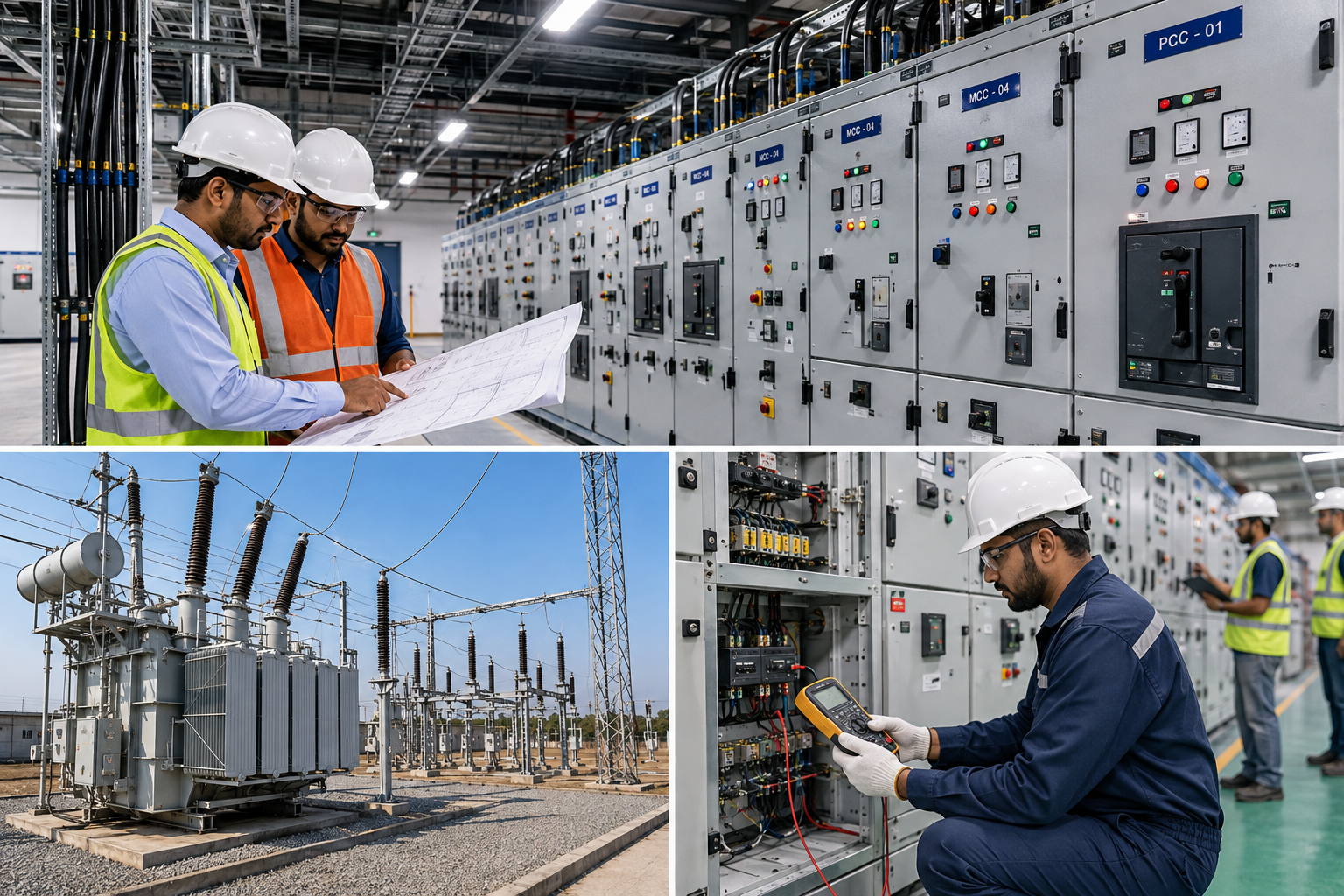
5. APFC Panels
Industrial facilities with significant inductive loads can require power-factor management.
An Automatic Power Factor Correction (APFC) panel uses capacitor stages and control logic to manage reactive power.
However, capacitor selection should not be treated independently of the electrical network.
Projects with substantial nonlinear loads should also evaluate harmonic conditions while designing power-factor correction equipment.
6. Industrial Power Cables
Cable selection is one of the largest procurement areas in many electrical projects.
Industrial installations can require:
LV power cables, MV cables, control cables, instrumentation cables and communication cables.
Control and instrumentation circuits have different requirements from power circuits.
For example, Polycab describes instrumentation cables as being designed for industrial control, communication and signal applications, with screened/shielded configurations intended to reduce external electrical interference.
The cable schedule should therefore be developed from actual plant requirements.
Cable Sizing Is More Than Choosing an Ampere Rating
Selecting industrial cable solely from full-load current can create problems.
Engineers normally need to consider factors such as:
Load current → installation method → derating → voltage drop → fault level → cable length → environment → final cable size
Ambient temperature, grouping, laying method and route conditions can influence permissible current carrying capacity.
Long cable runs can also create voltage-drop concerns.
For important feeders, short-circuit withstand must also be considered.
This is one reason large projects benefit from coordinated electrical engineering before procurement.
Industrial Earthing and Lightning Protection
Earthing is a fundamental part of industrial electrical safety.
Depending on the facility, the system may need to address:
equipment earthing, transformer neutral earthing, panel earthing, structure earthing, cable armour bonding, instrumentation grounding and lightning protection.
These systems should be coordinated instead of being installed as isolated earth pits without an overall engineering approach.
Final design depends on the facility, soil conditions, electrical system and applicable technical requirements.
Electrical Automation for Industrial Projects
Modern industrial projects increasingly combine electrical distribution with automation.
Automation can include:
PLC systems, VFDs, SCADA, process sensors, motor control, remote monitoring, alarms and energy monitoring.
A well-coordinated system allows plant teams to monitor equipment and operating conditions more effectively.
For example:
Sensor → PLC → control logic → VFD/MCC → motor/process equipment
SCADA or another supervisory platform can then provide operators with system visibility.
Integrating automation during electrical engineering is generally easier than trying to retrofit an entirely separate automation architecture after construction.
Energy Monitoring for Large Facilities
Large industrial electricity bills cannot be managed effectively using only the monthly utility bill.
A facility may need monitoring at multiple levels:
Incoming supply
↓
Transformer
↓
PCC
↓
MCC
↓
Production line
↓
Major machine
This makes it easier for plant teams to understand where electrical energy is being consumed.
Energy monitoring may also help identify unusual demand patterns, operating inefficiencies or opportunities for optimization.
Compliance and Electrical Safety
Industrial electrical projects must also account for applicable statutory and technical requirements.
The Central Electricity Authority currently publishes the CEA (Measures Relating to Safety and Electric Supply) Regulations, 2023, along with an Amendment Regulations, 2026.
CEA also lists the Technical Standards for Construction of Electrical Plants and Electric Lines Regulations, 2022, with subsequent amendments including 2025 and 2026 updates.
The exact rules and approvals applicable to a project depend on the installation, voltage level and other project-specific factors.
For this reason, compliance requirements should be checked during engineering rather than at the end of construction.
Testing and Commissioning
Installation is not the final stage of an industrial electrical project.
The system has to be inspected and tested before energisation.
Depending on equipment and project scope, commissioning activities may involve:
- Insulation resistance testing
- Continuity testing
- Earthing checks
- Cable testing
- CT/PT checks
- Relay testing
- Breaker operation testing
- Transformer checks
- Panel functional testing
- Interlock testing
- MCC sequence testing
- VFD parameter verification
- PLC I/O checking
- SCADA communication checks
- Trial operation
Test documentation should form part of the project records.
For large plants, commissioning also requires close coordination between electrical, mechanical, instrumentation, automation and process teams.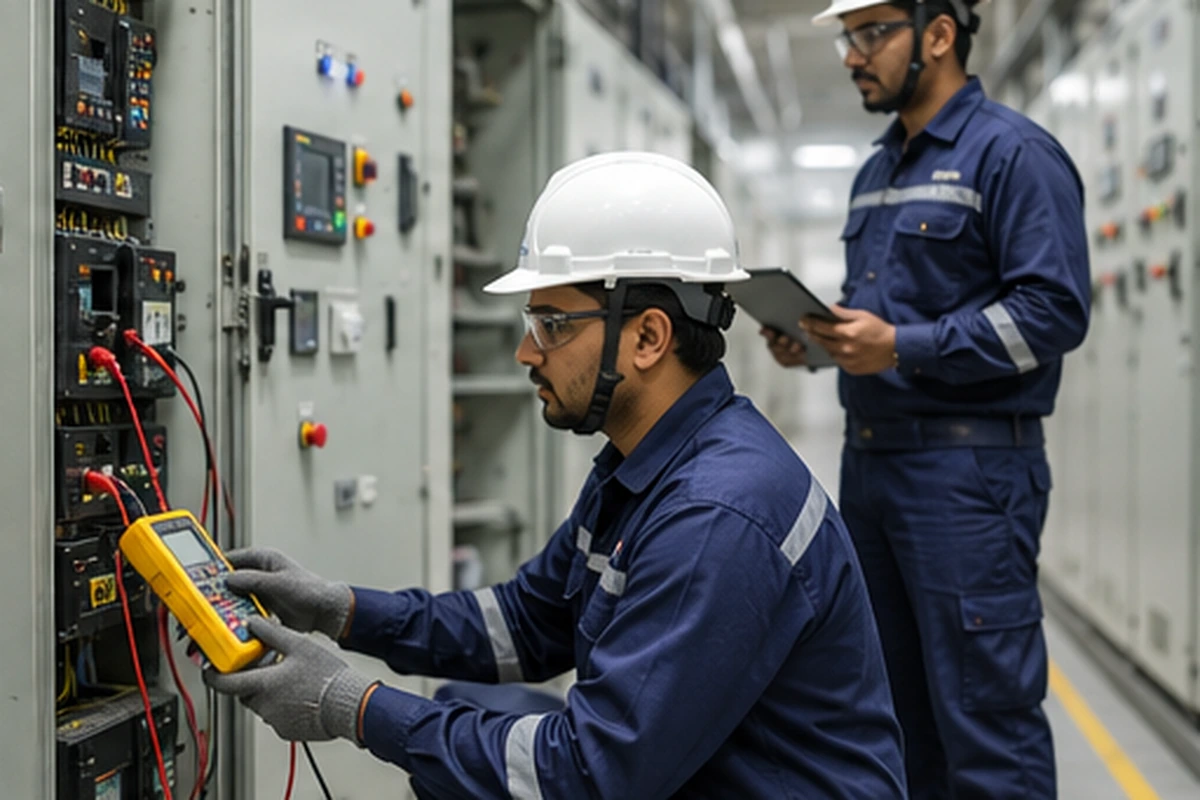
What Should You Look for in an Industrial Electrical Contractor?
For a large project, evaluate the contractor on more than the lowest quotation.
Look at its capability to understand drawings and BOQs, source specified equipment, coordinate multiple electrical systems, maintain project documentation and support testing and commissioning.
Also evaluate whether the contractor understands both electrical distribution and industrial automation.
This becomes particularly important where MCCs, VFDs, PLCs, instruments and SCADA systems must communicate with each other.
Why BOQ Accuracy Matters
The electrical BOQ is one of the most important documents in project procurement.
An incomplete BOQ can create repeated variation orders and project delays.
A detailed electrical BOQ may include:
HT equipment, transformer equipment, LT panels, bus ducts, power cables, control cables, instrumentation cables, cable trays, glands, lugs, earthing materials, lighting equipment, control devices and accessories.
Quantity alone is not enough.
The BOQ should also carry appropriate specifications.
For example, writing only:
“Cable – 500 metres”
is insufficient.
The project specification may also need conductor material, number of cores, cross-sectional area, voltage grade, insulation, armour requirement, applicable specification and application.
Better specifications reduce procurement ambiguity.
Electrical EPC for Greenfield Industrial Projects
Greenfield projects offer an opportunity to design the complete electrical system correctly from the beginning.
A typical workflow can be:
Load study
↓
Electrical architecture
↓
SLD
↓
Equipment sizing
↓
BOQ
↓
Vendor selection
↓
Procurement
↓
Installation
↓
Testing
↓
Commissioning
↓
Handover
Planning for future capacity is especially important.
Adding an additional production line later becomes much easier when the original transformer, panel arrangement, busbar system, cable routes and electrical rooms have been designed with expansion in mind.
Electrical EPC for Brownfield Plant Expansion
Existing factories present different challenges.
A brownfield project may require additional capacity without stopping existing production.
Before expansion, engineers may need to evaluate:
existing transformer loading, switchgear capacity, spare feeders, panel busbar capacity, cable routes, fault levels, earthing systems and existing protection philosophy.
Plant shutdown windows may also be limited.
Therefore brownfield projects often require more detailed planning and sequencing than greenfield construction.
Industries That Need Integrated Electrical EPC Services
The same core electrical principles apply across many sectors, but project requirements can differ considerably.
Industrial EPC services may be required for manufacturing plants, steel and metal processing, food-processing plants, chemicals, pharmaceuticals, warehouses and logistics facilities, hospitals, data centres, water-treatment systems, pumping installations and other major infrastructure projects.
Equipment selection should always reflect the actual process and operating environment.
Industrial Electrical Projects in West Bengal
West Bengal contains a mix of manufacturing, infrastructure, logistics, processing and heavy industrial activity.
Projects in areas such as Kolkata, Howrah, Haldia, Asansol and surrounding industrial regions may require a combination of electrical product supply, project execution and automation integration.
For major projects, it is useful to work with a supplier or contractor capable of supporting both technical selection and procurement.
That reduces coordination between multiple unrelated vendors.
Indian Automation – Electrical Products & Project Support
Indian Automation supports industrial customers with electrical products, electrical engineering services and automation solutions.
Project requirements may include:
industrial cables and wires, switchgear, MCC/PCC/control panels, industrial automation, sensors, PLC/VFD-related systems, electrical consultancy and project material supply.
For industrial requirements, the objective should be to identify the correct technical solution before finalizing the commercial proposal.
Have an Industrial Electrical Project or BOQ?
If you are planning a factory, manufacturing unit, plant expansion, warehouse, infrastructure project or major industrial electrical installation, send us your requirement.
You can share:
BOQ · SLD · Cable Schedule · Panel Schedule · Equipment List · Technical Specification · Project Drawings
Request an Industrial Project Quotation
Indian Automation
Electrical Products | Industrial Automation | Project Solutions
📞 Phone / WhatsApp: +91 9647150070
📧 Email: indian1automation@gmail.com
📍 Howrah, West Bengal
🌐 Website: indian-automation.com
Send Your BOQ for Project Quotation
What does an industrial electrical EPC contractor do?
An electrical EPC contractor can coordinate engineering, procurement, installation, testing and commissioning of the electrical systems required for an industrial project.
Can one contractor handle HT, LT, panels and industrial automation?
It depends on the contractor's technical capability and project scope. For integrated projects, working with a team that understands power distribution, control panels and automation can simplify coordination.
What information should we send for an industrial electrical quotation?
For an accurate quotation, provide the BOQ, single-line diagram, technical specification, cable schedule, panel schedule and relevant project drawings whenever available.
Can Indian Automation quote for bulk electrical material requirements?
Yes. Industrial and project requirements can be shared with Indian Automation for technical review and quotation.
Do you handle industrial projects outside Kolkata?
Project requirements can be discussed for Kolkata, Howrah, Haldia, Asansol, other parts of West Bengal and suitable projects elsewhere in India.
Can we submit only a BOQ for quotation?
Yes. If your project BOQ is already prepared, send it for review. Additional technical information may be requested where specifications are incomplete
Contact Indian Automation for product supply, quotations and electrical/automation services.
WhatsApp for a Quote