Electrical BOQ & Material Procurement Checklist for Large Industrial Projects

Electrical procurement for a large industrial project is very different from purchasing electrical materials for routine maintenance.
A new manufacturing plant, process facility, warehouse, infrastructure project or major factory expansion can involve thousands of metres of power and control cables, HT and LT equipment, MCC and PCC panels, transformers, cable trays, earthing systems, automation hardware, instruments and hundreds of smaller accessories.
A missing specification in the electrical BOQ can result in quotation differences, material substitutions, additional costs and delays during installation.
For EPC companies, project owners, electrical consultants and procurement teams, the BOQ should therefore be treated as an important engineering document—not simply a purchasing spreadsheet.
This guide explains how industrial electrical BOQs should be structured and what should be checked before issuing a large material enquiry.
What Is an Electrical BOQ?
BOQ means Bill of Quantities.
For an industrial electrical project, the BOQ identifies the equipment, materials, quantities and technical requirements that need to be procured or installed.
A simple description such as:
“4 core cable – 1,000 metres”
is usually not detailed enough for a serious industrial quotation.
A procurement team may need to know the conductor material, conductor size, voltage grade, insulation, sheath, armour configuration, applicable specification and installation requirement.
The purpose of a properly prepared BOQ is therefore to ensure that the engineering team, consultant, contractor, supplier and procurement department are all quoting the same technical requirement.
Why BOQ Accuracy Matters in Large Projects
Industrial procurement decisions can affect the entire electrical system.
Suppose three vendors receive a BOQ containing only:
“250 A MCCB – 20 Nos.”
One supplier may quote a basic fixed MCCB.
Another may include adjustable protection.
A third may quote a different breaking capacity or accessory configuration.
Although all three quotations appear to satisfy the BOQ description, technically they may represent very different products.
This can make a price comparison misleading.
A stronger BOQ specifies the parameters necessary for technically equivalent bids.
For large projects, that can significantly improve commercial comparison and reduce clarification cycles.
Start With Engineering Documents Before Preparing the BOQ
The electrical BOQ should ideally originate from approved engineering information.
The Single Line Diagram establishes the electrical distribution architecture.
Load schedules indicate connected loads and demand.
Cable schedules define feeders and routes.
Panel schedules identify incomers and outgoing circuits.
Equipment layouts help determine installation quantities.
Earthing layouts determine conductors, pits, strips and accessories.
Automation architecture defines PLC, VFD, communication and control requirements.
When procurement begins before these documents are sufficiently developed, quantities and specifications are more likely to change later.
Main Electrical Procurement Packages
For a large industrial project, procurement is easier to control when materials are divided into logical packages.
A practical industrial electrical procurement checklist can include:
- HT switchgear, VCBs, RMUs and protection equipment
- Power transformers and associated accessories
- PCC, MCC, APFC and distribution panels
- ACBs, MCCBs, MCBs and protection devices
- LV, MV and other power cables
- Control cables and instrumentation cables
- Cable trays, ladders and cable-support systems
- Cable glands, lugs, ferrules and termination accessories
- Bus ducts or busbar trunking where applicable
- Earthing conductors, strips, electrodes and accessories
- Lightning-protection equipment
- VFDs, soft starters and motor-control equipment
- PLC, HMI and SCADA equipment
- Field instruments, sensors and control devices
- Industrial lighting and lighting-control equipment
- Energy meters and power-monitoring devices
- Junction boxes and local control stations
- Electrical installation consumables
- Testing and commissioning requirements
- Documentation, drawings, certificates and final handover records
The actual package structure should be adapted to the project design rather than copied unchanged between projects.
1. HT and MV Electrical Equipment
Facilities receiving power at higher voltage may require an HT or MV procurement package.
Depending on the project, this can include incoming switchgear, VCB panels, protection relays, metering, CTs, PTs, RMUs and associated control equipment.
The BOQ should identify system voltage, current rating, fault-level requirements, protection philosophy, control supply and required interfaces.
Applicable project standards and statutory requirements should also be considered before procurement.
India's Central Electricity Authority currently lists the Measures Relating to Safety and Electric Supply Regulations, 2023, together with an Amendment Regulations, 2026. Project teams should verify the regulations and approvals applicable to their particular installation rather than relying on outdated project templates.
2. Transformer Procurement
A transformer should not be specified only by kVA rating.
For industrial procurement, the enquiry can require information such as voltage ratio, vector group, impedance, cooling arrangement, tap arrangement, temperature-rise requirements, accessories, protection interfaces and installation conditions.
The transformer requirement should originate from the electrical system design.
Future plant expansion should also be considered where appropriate.
Procurement teams should avoid changing transformer characteristics purely to obtain a cheaper commercial offer without engineering approval.
3. PCC and MCC Panel BOQ
Electrical panels are often among the most specification-sensitive packages in an industrial project.
For a PCC, the BOQ or technical specification may need to define incoming arrangement, busbar rating, short-circuit withstand requirement, ACB/MCCB configuration, outgoing feeders, meters, protection devices and communication requirements.
For an MCC, additional requirements may involve motor ratings, starter type, VFD feeders, soft starters, local/remote control, PLC interfacing and equipment status signals.
Instead of specifying only:
“MCC Panel – 1 No.”
the procurement package should include the relevant panel schedule and approved SLD.
This allows panel builders and suppliers to quote against an actual feeder configuration.
4. Industrial Cable Procurement
Cable procurement deserves particular attention because cables can represent a significant portion of an industrial electrical package.
Different applications require different cable types.
Polycab's current industrial cable portfolio includes categories such as LV power cables, MV power cables, instrumentation cables and other specialized cable ranges.
Its MV power-cable range, for example, covers applications from approximately 3.3 kV to 66 kV and is intended for applications including industries, utilities, power plants and power-distribution networks.
Control cables have a different purpose. Polycab currently describes control cables ranging from 2-core through 61-core configurations, with armoured and unarmoured options and PVC or XLPE insulation variants.
Instrumentation cables are designed for control, communication and signal applications where shielding can help reduce external electrical interference.
This is why a single generic line such as “electrical cable” should normally be avoided in a large industrial BOQ.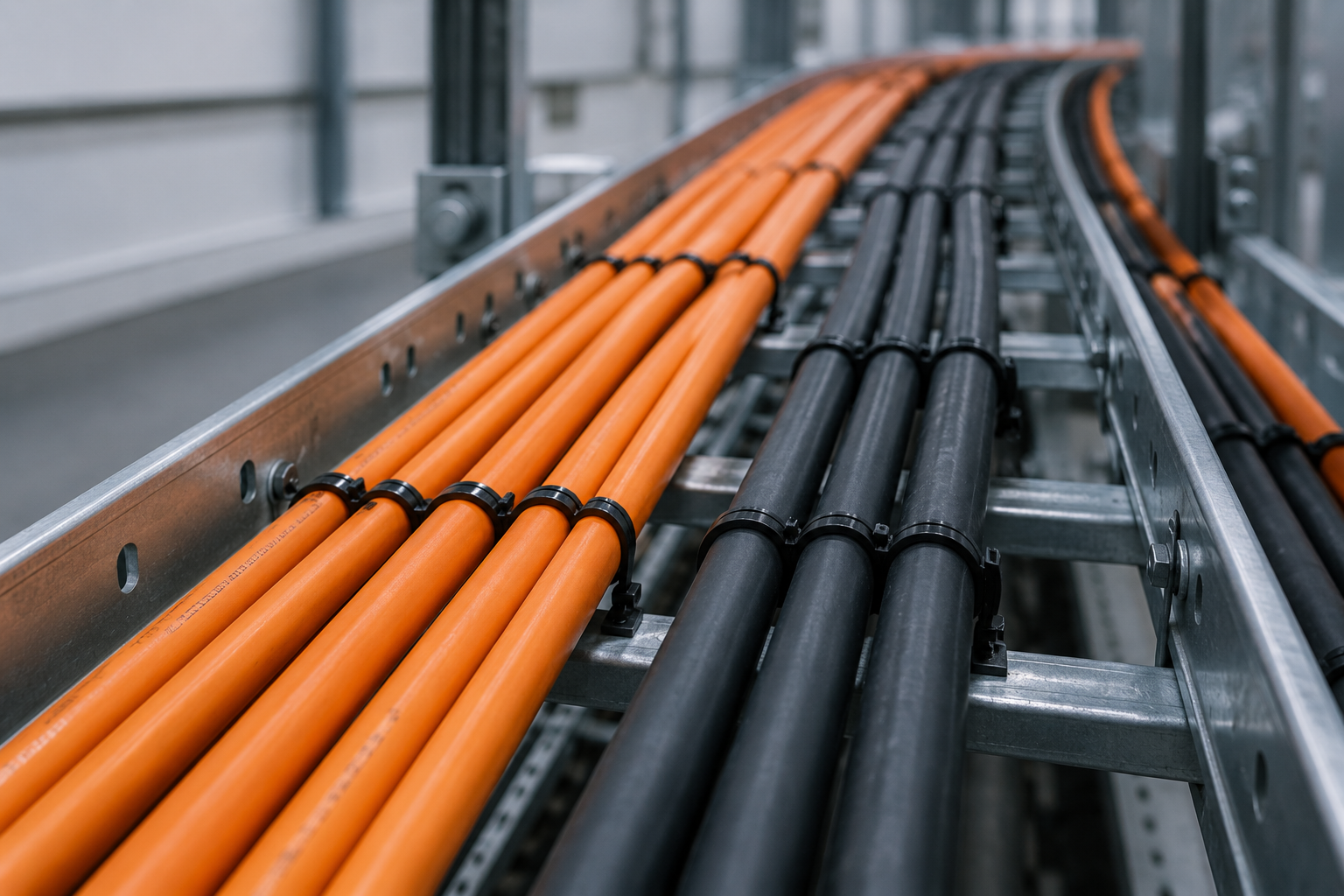
How to Write a Better Cable BOQ Description
Consider this weak specification:
Power Cable – 4C × 120 sq.mm – 2,000 metres
It gives some information, but procurement still needs clarification.
A project specification may additionally define:
Conductor: Copper or aluminium
Voltage grade: As required by system
Insulation: XLPE/PVC or project-specific requirement
Armour: Armoured/unarmoured
Outer sheath: As specified
Core identification: As required
Application: Power feeder
Quantity: Based on approved cable schedule
Applicable specification: As stated in project documentation
The objective is not to add unnecessary words.
The objective is to remove ambiguity.
5. Cable Tray and Support-System Procurement
Cable trays are often underestimated during early BOQ preparation.
Projects may require ladder-type trays, perforated trays, covers, bends, tees, reducers, vertical bends, couplers and structural supports.
Simply calculating the straight route length may not represent the final material requirement.
The BOQ should be developed from cable routing and layout drawings wherever possible.
Different tray systems may also be required for power, control and instrumentation cables depending on the design philosophy.
6. Cable Glands, Lugs and Termination Accessories
Large electrical projects can require hundreds or thousands of cable terminations.
Yet glands and lugs are frequently treated as minor consumables.
Incorrect quantities can delay panel termination even when all major equipment has already reached site.
Accessory selection should correspond to cable size, number of cores, armour construction, enclosure requirements and termination equipment.
Maintaining a termination schedule can make procurement considerably easier.
7. Earthing Material BOQ
Industrial earthing should be based on an engineered earthing design.
The BOQ can include earth electrodes, GI or copper strips, conductors, equipment-earth connections, earth-pit accessories, test links and bonding components.
Quantities should correspond to approved layouts.
Electrical safety requirements should also be reviewed against the applicable CEA framework and project-specific requirements.
A frequent procurement mistake is purchasing earthing material based only on rough area estimates without considering the final equipment layout.
8. APFC and Power-Quality Equipment
APFC panels are used where reactive-power compensation is required.
However, industrial facilities containing substantial nonlinear loads may require additional assessment of harmonic conditions.
Procurement should therefore follow the electrical study and approved specification.
The cheapest capacitor-panel quotation is not automatically the best engineering solution.
The BOQ should state relevant panel capacity, step configuration, switching arrangement, controller requirements and any harmonic-related design requirements identified by the project engineer.
9. VFD and Motor-Control Procurement
VFD selection requires more information than only the motor kW rating.
The application matters.
A pump, conveyor, compressor and heavy starting load can have different operating characteristics.
The BOQ should therefore identify motor rating, supply voltage, application, control method, enclosure/environmental requirement, communication requirement and important accessories.
Where the VFD interfaces with a PLC or SCADA system, the communication architecture should be defined before ordering equipment.
10. PLC, SCADA and Automation BOQ
Automation procurement should not be isolated from the electrical package.
MCC feeders may need PLC signals.
VFDs may need network communication.
Energy meters may need data integration.
Field instruments may require specific I/O types.
An automation BOQ should therefore correspond to an approved I/O list, control philosophy and system architecture.
For manufacturing and process-control applications, Polycab also identifies power, control, panel-wire, BUS and instrumentation-cable applications within automation and process-control environments.
Include Documentation in the Purchase Requirement
Large electrical procurement should not finish when equipment reaches the site.
Required documentation can form part of the purchase specification.
Depending on the package, this may include approved drawings, datasheets, routine test certificates, inspection records, manuals, wiring diagrams, terminal diagrams, spare-part lists and final as-built documentation.
Requiring documentation after equipment has already been delivered can result in unnecessary delays.
Technical Bid Comparison Before Commercial Comparison
For major industrial packages, evaluating only the lowest price is risky.
The first question should be:
Are all vendors quoting technically equivalent equipment?
A structured technical comparison can identify deviations in ratings, materials, protection, accessories, standards, quantities and exclusions.
Only after important technical deviations have been resolved does the commercial comparison become meaningful.
For high-value procurement, this can prevent a low initial quotation from later becoming expensive through change orders and exclusions.
Vendor Evaluation for Industrial Projects
Industrial vendors should be evaluated against project needs.
Important considerations can include technical capability, product authenticity, supply capacity, manufacturing or sourcing lead time, documentation quality, after-sales support and ability to respond during commissioning.
For project-critical equipment, delivery reliability can be as important as price.
A low-cost component arriving several weeks after the required commissioning date can have a much larger impact on project cost than the original purchase-price saving.
Avoid Unauthorized Material Substitution
Procurement teams often receive alternative-brand proposals.
Alternatives are not automatically unacceptable.
However, substitutions should be reviewed against the approved technical requirements.
The correct process is:
Proposed alternative → technical comparison → consultant/client approval → purchase
rather than:
Cheaper alternative → purchase → request approval afterwards
For large projects, maintaining this discipline protects both engineering quality and project documentation.
Procurement Planning for Long-Lead Equipment
Not every electrical item has the same delivery period.
Major equipment such as customized panels, transformers, HT equipment and certain specialized systems can require design approval and manufacturing time.
Procurement should therefore be linked to the construction schedule.
A useful sequence is:
Engineering freeze → technical specification → RFQ → technical evaluation → commercial negotiation → PO → drawing approval → manufacturing → inspection → dispatch → installation → commissioning
This approach makes the purchasing process part of project planning rather than an independent administrative activity.
Material Inspection at Site
When equipment arrives, the receiving team should verify it against the purchase order and approved specification.
For major equipment, inspect nameplate information, physical condition, accessories, quantities and relevant documents before accepting the material for installation.
Any transit damage or mismatch should be documented promptly.
This is particularly important for electrical equipment that may remain stored for some time before installation.
BOQ Management for Greenfield Projects
Greenfield factories usually involve a large integrated BOQ.
The challenge is keeping the electrical architecture consistent across transformers, panels, cables, motors, automation and instrumentation.
A master procurement schedule can track each package from enquiry through approval, manufacturing and delivery.
Changes to engineering documents should also be reflected in the latest BOQ revision.
Otherwise purchasing teams can accidentally order material from superseded drawings.
BOQ Management for Brownfield Expansion Projects
Brownfield projects require additional care because new equipment must integrate with existing systems.
Before procurement, project engineers may need to verify existing switchgear ratings, spare feeders, transformer loading, available panel space, cable routes and shutdown requirements.
Actual site conditions should be verified rather than relying solely on old drawings.
This can prevent purchasing new equipment that cannot be easily integrated into the operating plant.
Electrical Procurement for Industrial Projects in West Bengal
Industrial projects across Kolkata, Howrah, Haldia, Asansol and other regions of West Bengal can involve substantial requirements for cables, switchgear, electrical panels, automation equipment and project materials.
The procurement challenge becomes greater when materials are purchased from many unrelated vendors.
For major projects, consolidating technical review and procurement coordination can reduce communication gaps between engineering, supply and execution teams.
Indian Automation — Industrial Electrical Material & Project Support
Indian Automation supports industrial and project customers requiring electrical materials, automation products and electrical project solutions.
Requirements can include industrial cables, electrical panels, switchgear, control products, automation equipment and associated project materials.
For accurate quotations, industrial customers should share as much project information as possible rather than requesting pricing from only a generic material description.
Send Your Electrical BOQ for Project Quotation
If you are working on a:
factory project · manufacturing plant · industrial expansion · warehouse · infrastructure development · process plant · EPC project
you can send your electrical requirement to Indian Automation.
Share your:
BOQ · SLD · Cable Schedule · Panel Schedule · Technical Specification · Equipment List · Drawings
Indian Automation
Industrial Electrical Products | Automation | Project Solutions
📞 Phone / WhatsApp: +91 9647150070
📧 Email: indian1automation@gmail.com
📍 Howrah, West Bengal
Need help?
Upload / Send Your BOQ for Quotation
FAQs
What information should an industrial electrical BOQ contain?
It should clearly identify equipment or material descriptions, quantities and the technical specifications required to obtain comparable quotations.
Can I send Indian Automation an existing BOQ for quotation?
Yes. You can share your BOQ, SLD, cable schedule, panel schedule or technical specification for review and quotation.
Why should technical evaluation happen before price comparison?
Two quotations can appear to cover the same material while differing in ratings, accessories, construction or exclusions. Technical comparison helps establish whether the offers are actually equivalent.
What cable information should be included in an industrial BOQ?
Depending on the project, this can include conductor size/material, cores, voltage grade, insulation, armour, sheath, application, quantity and relevant project specification.
Can one BOQ include cables, switchgear, panels and automation products?
Yes. A master electrical BOQ can contain multiple packages, although separating major equipment categories generally makes procurement and comparison easier.
Do you support bulk material requirements for industrial projects?
Industrial bulk requirements can be shared with Indian Automation for technical review and commercial quotation.
Contact Indian Automation for product supply, quotations and electrical/automation services.
WhatsApp for a Quote